How to Audit Robots.txt for Search, Training, and AI Answer Engines
Learn how to audit your robots.txt file to manage AI search engine visibility and content access. Discover how to configure directives for training and retrieval bots.

Auditing your robots.txt file for AI answer engines requires distinguishing between search crawlers, retrieval bots, and training crawlers. While traditional search crawlers index your pages for standard search engines, retrieval bots fetch content to generate citations in AI answers, and training bots scrape text to build model datasets. Managing these permissions precisely allows you to control which agents access your content, helping maintain visibility in conversational search results while restricting training access.
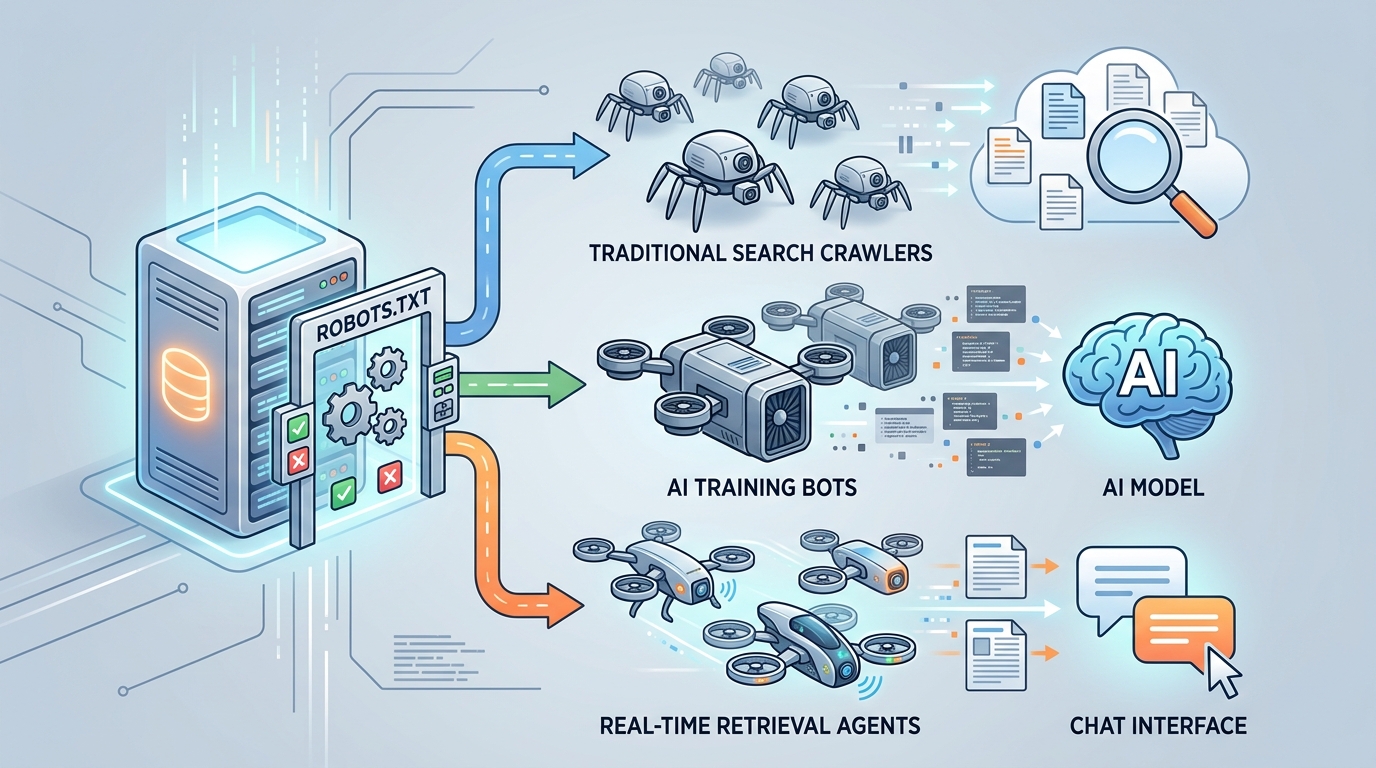
Understanding the Three Classes of AI Bots
Web crawling has diversified beyond the traditional search indexers that have populated the internet for decades. To establish a precise robots.txt configuration, you must distinguish between three primary classes of automated agents: traditional search engine crawlers, offline training crawlers, and real-time retrieval agents. Each class interacts with your web server differently and serves a distinct functional purpose within the broader search and artificial intelligence ecosystems. Understanding these technical distinctions is the first step in managing how external systems access your web assets.
Traditional search engine crawlers, such as Googlebot or Bingbot, are designed to discover, fetch, and parse web pages to populate public search indexes. These crawlers operate on a continuous cycle of discovery and re-indexing. The data they collect is processed to rank pages in standard search engine results pages based on relevance, authority, and technical performance. Blocking these crawlers prevents your pages from being indexed, which stops your website from appearing in standard organic search results and eliminates that source of inbound traffic.
Offline training crawlers, such as GPTBot or ClaudeBot, gather large volumes of textual data to train large language models. These bots do not index content for immediate retrieval or real-time user queries. Instead, they download text to build massive datasets used during the pre-training or fine-tuning phases of model development. The ingested content helps the model learn grammar, syntax, factual relationships, and semantic structures. Because this process does not generate direct referral traffic or real-time citations, many operators choose to restrict these bots to protect proprietary text.
Real-time retrieval agents, such as ChatGPT-User or PerplexityBot, operate dynamically on behalf of an active user session. When a user submits a query to an AI assistant that requires current or specific information, the system deploys a retrieval agent to fetch the contents of relevant web pages in real-time. This content is then fed into the model's context window to generate a response that includes direct citations and links back to the source. Restricting these agents prevents the AI engine from reading your pages during a live query, which means your content cannot be used to answer the user's question or receive a citation.
- Traditional Search Crawlers: Focus on indexing for standard search engine results pages.
- Offline Training Crawlers: Ingest content to build and train future language models.
- Real-Time Retrieval Agents: Fetch live web pages to answer active user queries with direct citations.
Identifying Key AI and Search User-Agents
To manage crawler access, you must target the specific User-Agent strings declared by each bot in its HTTP request headers. The robots.txt file uses these strings to match incoming requests with the corresponding directives. A common error is applying broad wildcard directives that treat all automated agents identically. This approach fails to distinguish between training bots and retrieval bots, often leading to accidental blocks that remove a site from search results entirely.
OpenAI, for instance, maintains separate user-agents for different tasks. GPTBot is the crawler used to collect data for model training. In contrast, ChatGPT-User is the agent used when a user asks ChatGPT to browse the live web for information. If your goal is to prevent your content from being used in model training while still allowing your pages to be cited in real-time ChatGPT responses, you must configure separate rules for each user-agent rather than blocking all OpenAI traffic.
Google operates under a similar multi-agent structure. Googlebot remains the primary crawler for standard search indexing. To allow webmasters to opt out of AI training without affecting their search presence, Google introduced the Google-Extended user-agent. Disallowing Google-Extended prevents your content from being used to train Gemini and Vertex AI models, while leaving Googlebot unblocked ensures your pages continue to be indexed and displayed in standard Google search results.
Other AI developers, such as Anthropic and Perplexity, also use dedicated user-agents. Anthropic uses ClaudeBot for both training and real-time retrieval tasks, meaning a block on ClaudeBot affects both functions. Perplexity uses PerplexityBot primarily for real-time retrieval to generate answers and citations for its users. Identifying these specific strings allows you to write precise directives that align with your visibility and data protection requirements.

Configuring Directives for Retrieval vs Training
Writing clear and technically accurate robots.txt directives requires an understanding of how different parsers interpret the Robots Exclusion Protocol. The standard syntax consists of a User-agent line followed by one or more Disallow or Allow directives. Modern parsers read these rules to determine whether a specific crawler is permitted to fetch a given URL path. Because different parsers may resolve conflicting rules differently, clarity and simplicity in your file structure are essential.
Under the RFC 9309 specification, which formalizes the Robots Exclusion Protocol, parsers match user-agents by finding the most specific match. If a crawler matches multiple user-agent declarations, it will follow the directives in the most specific block. For path matching, the parser evaluates all matching directives and applies the one with the longest path length. For example, if you have Disallow: / and Allow: /blog/, a crawler attempting to access /blog/article will follow the Allow directive because it has a longer, more specific path.
When configuring your file, place specific user-agent blocks at the top, followed by more general blocks, and end with the global wildcard (User-agent: *) block. This logical flow helps human editors review the file and reduces the likelihood of parsing errors. Avoid using complex regular expressions or non-standard wildcards, as some simpler parsers do not support them and may ignore the directive entirely, leading to unexpected crawling of restricted directories.
The Risk of Over-Blocking: Losing AI Search Citations
A common response to concerns about AI data collection is to implement a blanket block on all AI-related user-agents. While this approach prevents training crawlers from downloading your content, it also blocks real-time retrieval agents. When an AI answer engine cannot access your site, it cannot evaluate your content to answer user queries. Consequently, when users search for information related to your industry, the AI engine will retrieve and cite competitor websites that allow access.
The loss of these citations can significantly reduce your visibility in conversational search results. Unlike traditional search engines that present a list of links, AI answer engines synthesize information into a direct response and provide citations as footnotes or inline links. Users who interact with these engines rely on these citations to find the source of the information. If your site is blocked, your brand is excluded from these synthesized answers, eliminating your presence in this search channel.
To maintain visibility, you must implement a selective configuration. By allowing real-time retrieval agents while disallowing offline training crawlers, you permit AI engines to read your content for the sole purpose of answering active user queries. This approach protects your intellectual property from being used to train models offline while preserving your ability to secure citations and referral traffic from conversational search queries.

Limitations and suitability
It is critical to understand that robots.txt is a voluntary protocol and does not function as a security mechanism. Compliance relies entirely on the crawler respecting the directives. While major search engines and reputable AI developers adhere to these rules, malicious scrapers, unauthorized bots, and less compliant AI startups often ignore robots.txt entirely. Relying solely on this file to protect sensitive, proprietary, or copyrighted data is insufficient.
Furthermore, robots.txt directives do not operate retroactively. If an AI crawler has already downloaded your content and integrated it into a model's training weights, updating your robots.txt file will not remove that data from the existing model. The file only controls future crawling activity. To address historical data ingestion, you must use other methods, such as direct removal requests, or accept that the existing model weights cannot be altered through robots.txt changes.
For robust content protection, you must combine robots.txt directives with active technical controls. These include implementing server-side rate limiting to block rapid, repetitive requests, requiring user authentication for sensitive directories, and using web application firewalls to block known malicious IP addresses. Cryptographic verification of crawler identities, such as performing reverse DNS lookups, also helps ensure that only legitimate, compliant bots are allowed to access your server.
How YAS AI Visibility Evaluates Crawler Access
Managing these technical configurations requires continuous auditing and validation. YAS AI Visibility is an independent GEO and AI-search visibility product that audits how AI answer engines can access, understand, trust, and cite a website. The platform conducts evidence-backed technical, content, entity, and visibility analysis to identify potential conflicts and optimization opportunities within your robots.txt file and broader site structure.
Through technical analysis, the platform evaluates whether your robots.txt directives are configured correctly to allow real-time retrieval while restricting unauthorized training. This audit helps identify syntax errors, conflicting rules, or accidental blocks that could prevent legitimate AI search engines from accessing your pages. By verifying these configurations, you can confirm that your site remains accessible to the agents responsible for generating real-time citations.
In addition to technical checks, YAS AI Visibility analyzes content and entity structures to determine how effectively AI engines can parse and understand your information. This comprehensive approach helps clarify how retrieval agents access your pages, and how the content is structured so that the AI engine can parse, trust, and cite it in its responses. This evidence-backed analysis provides clear data to help you optimize your overall AI search visibility.
Verifying and Testing Your Directives
After updating your robots.txt file, you must verify that the changes are active and correctly interpreted by external crawlers. You can perform initial validation using online testing tools or command-line parsers to simulate how different user-agents read your directives. These tools can identify basic syntax errors or logical conflicts, but they do not confirm how actual crawlers interact with your live server.
The most reliable way to verify crawler behavior is by analyzing your web server access logs. These logs record every HTTP request made to your server, including the client's IP address, the requested URL, the HTTP status code, and the User-Agent string. By filtering your logs for specific AI user-agents, such as GPTBot or ChatGPT-User, you can confirm whether they are accessing disallowed paths or if they are receiving the correct response codes.
Monitoring access logs also allows you to detect spoofed user-agents. Some unauthorized scrapers alter their User-Agent string to mimic legitimate search or AI bots to bypass blocks. To verify the authenticity of a crawler, you must perform a reverse DNS lookup on the requesting IP address. Legitimate bots from major search and AI companies will resolve to official, verifiable domains, allowing you to distinguish between compliant agents and unauthorized scrapers.
| User-Agent | Primary Purpose | Operator | Impact of Disallowing |
|---|---|---|---|
| GPTBot | Model Training | OpenAI | Instructs OpenAI not to ingest content for training; does not affect real-time search. |
| ChatGPT-User | Real-Time Retrieval | OpenAI | Instructs ChatGPT not to fetch pages in real-time, which stops the engine from citing the site in active user queries. |
| Google-Extended | Model Training | Instructs Google not to use content for training Gemini and Vertex AI models; does not affect Google Search indexing. | |
| ClaudeBot | Training and Retrieval | Anthropic | Instructs Anthropic not to use content for training and prevents Claude from reading pages in real-time. |
| PerplexityBot | Real-Time Retrieval | Perplexity | Instructs Perplexity not to fetch pages in real-time, which stops the engine from citing the site. |
Five Essential Steps to Audit and Deploy Your AI-Ready Robots.txt
- Identify and catalog your proprietary content assets that require protection from offline training.
- Map out the specific AI search engines where your brand must maintain visibility and citation traffic.
- Draft separate directives for training crawlers like GPTBot and real-time retrieval crawlers like ChatGPT-User.
- Validate your robots.txt syntax using a parser to ensure no accidental wildcards block legitimate search engines.
- Monitor your server access logs weekly to verify that AI crawlers are respecting the directives and to detect spoofed user-agents.
Managing robots.txt in the AI era is about the precise technical allocation of access rights—distinguishing between the crawlers that build offline models and the retrieval agents that cite your site in real-time search.
FAQ
Does blocking GPTBot stop ChatGPT from citing my website?
No. GPTBot is used for training future models, while ChatGPT-User is used for real-time retrieval. Disallowing GPTBot instructs OpenAI not to use your content for training while still allowing ChatGPT to fetch and cite your pages in real-time.
What is Google-Extended and how does it differ from Googlebot?
Google-Extended is a standalone token that allows webmasters to opt out of having their content used to train Google's Gemini and Vertex AI models. Disallowing Google-Extended does not affect your site's indexing or ranking in traditional Google Search.
Can robots.txt prevent AI engines from using my content if it has already been scraped?
No. Robots.txt only controls future crawling. If your content has already been ingested into a model's training dataset, updating your robots.txt will not retroactively remove it.
How do I verify if a crawler claiming to be an AI bot is legitimate?
You must perform a reverse DNS lookup on the IP address of the crawler. Legitimate bots from OpenAI, Google, and Anthropic will resolve to their respective official domains.
Will blocking ClaudeBot affect my visibility on Anthropic's platform?
Yes. Anthropic uses ClaudeBot for both training and real-time web search tasks. Blocking ClaudeBot will prevent Claude from accessing your pages to answer real-time user queries.
Is robots.txt legally binding for AI companies?
No. Robots.txt is a voluntary standard. While major AI companies like OpenAI, Google, and Anthropic respect it, many smaller or rogue scrapers ignore it entirely.