AI Search ROI: Connect Visibility Evidence to Traffic and Conversion Measurement
Build an AI search ROI model that connects observed visibility evidence to traffic and conversion measurement without claiming attribution you cannot verify.
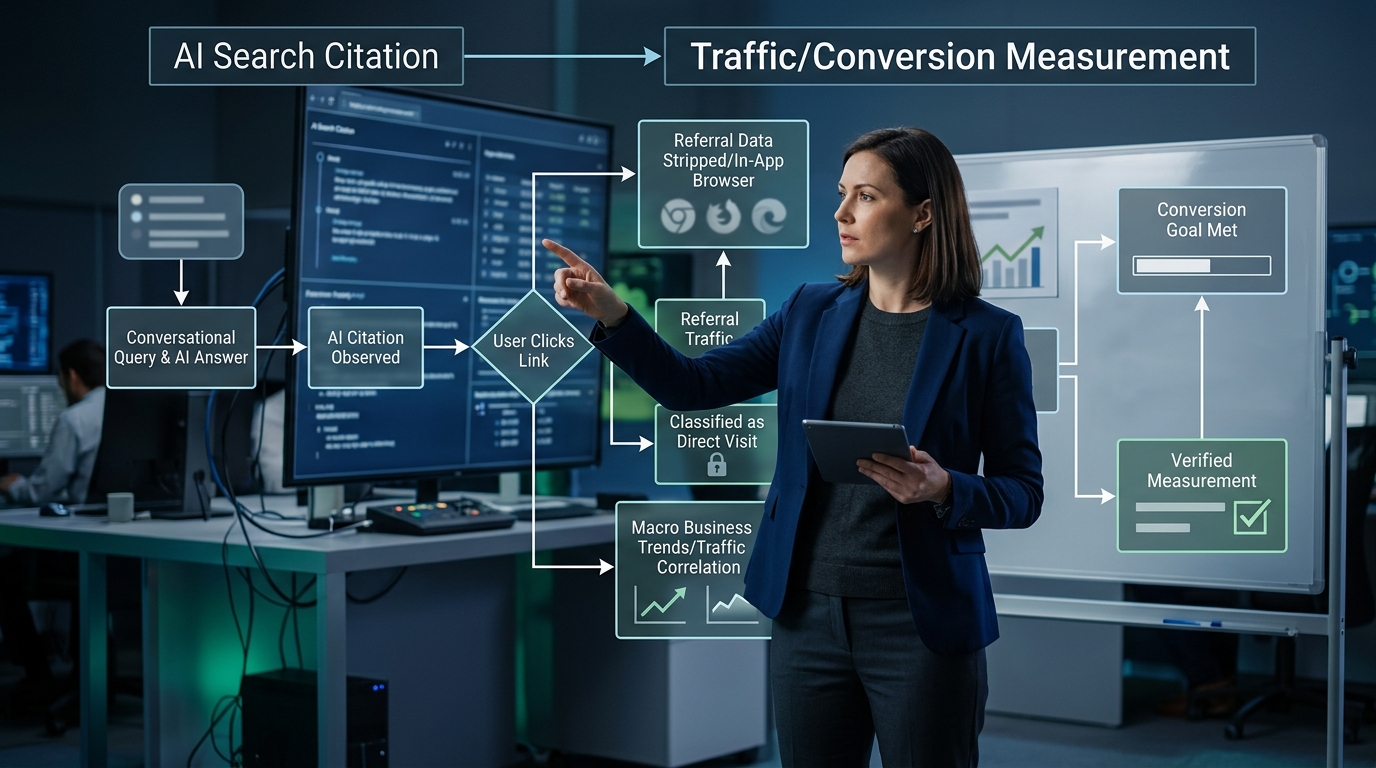
AI search ROI cannot be inferred from a mention or citation alone. A credible assessment connects observed visibility evidence to traffic, assisted conversions, and changes that can be independently measured. YAS AI Visibility helps teams define questions, capture evidence, and separate correlation from confirmed impact before they decide which technical or editorial improvement deserves investment.
The attribution deficit in conversational search
Website operators face a significant challenge when attempting to measure the return on investment of AI search optimization. Traditional search engine optimization relies heavily on structured click data, search volume estimates, and clear keyword attribution. In contrast, AI answer engines often resolve user queries directly within their chat interfaces. This zero-click behavior satisfies the user's information need without generating a visit to the source website. When a user does decide to click a citation link, the referral data is frequently obscured.
Many AI platforms route traffic through in-app browsers, strip referrer headers, or present links in ways that web analytics tools classify as direct traffic. This lack of clean attribution makes it difficult to justify the technical and editorial resources required to optimize for these engines. To build a reliable ROI model, teams must shift their focus from direct click attribution to a multi-layered measurement framework that combines observed visibility evidence with downstream traffic signals. This requires an understanding of how crawlers access and parse your site.
Without a structured approach to tracking, organizations risk making arbitrary decisions about their digital content. They may overinvest in optimizing for platforms that do not drive traffic, or they may completely ignore engines that are actively shaping buyer perception. By establishing clear questions and capturing evidence, operators can begin to separate correlation from confirmed impact before they decide which technical or editorial improvement deserves investment.
Establishing a baseline of observed visibility evidence
Before you can measure the financial impact of AI search visibility, you must first establish a reliable baseline of how often your brand, products, or resources are cited. This requires systematic tracking of high-intent queries across major LLM-based search engines. Because these engines do not provide a public keyword database or search volume tool, visibility must be measured through automated, evidence-backed audits. These audits evaluate whether your content is accessible to the engine's crawler, whether the model understands your entity relationships, and whether it chooses to reference your site as a trusted source.
An effective baseline tracks specific metrics such as citation share, entity sentiment, and the presence of direct links in answers. By documenting these data points over time, you create a historical record of your AI search footprint. This evidence serves as the foundation for your ROI calculations, allowing you to compare periods of high visibility against fluctuations in direct and organic traffic. Without this baseline, any subsequent traffic analysis is merely speculative.
This baseline must be built on technical reality. You must verify that your site's robots.txt directives allow access to specific user-agents like GPTBot, PerplexityBot, or ClaudeBot. If these crawlers are blocked, the engine cannot access your latest content, rendering any discussion of visibility moot. Therefore, technical accessibility is the first and most critical component of your baseline evidence.

Isolating referral traffic from AI search engines
While direct attribution is challenging, a significant portion of AI search traffic can still be isolated within your web analytics platform. This process begins by identifying the unique referrer domains and user-agents associated with major AI search platforms. For example, traffic from ChatGPT, Perplexity, or Claude often carries distinct referrer strings, though these can change as the platforms update their infrastructure. Monitoring these specific referrers allows you to build custom segments that isolate users arriving directly from conversational interfaces.
Additionally, operators should monitor Google Search Console to track how Google's AI-generated features affect traditional search performance. According to the Search Console documentation from Google Search Central, monitoring and debugging through the console remains a critical step in understanding how search crawlers interact with your site. While Google does not currently separate AI Overview clicks from standard organic clicks in its default reports, analyzing query-level performance and page-level traffic shifts during known algorithm updates can help you infer the impact of Google's AI features on your overall search visibility.
By combining these data sources, you can create a composite view of your conversational search traffic. This view will never be 100% accurate due to technical limitations like browser privacy settings and referrer stripping, but it provides a consistent, repeatable metric that you can track over time. The goal is not absolute precision, but rather a reliable indicator of directional trends.
Connecting visibility shifts to conversion outcomes
Once you have isolated a stream of AI search referral traffic, the next step is to connect these visits to tangible business outcomes, such as signups, leads, or revenue. Users who click through from an AI search engine often exhibit different behavior than traditional search visitors. Because they have already received a synthesized answer to their query, they are frequently further down the purchase funnel and possess higher intent. Consequently, these visitors may show higher conversion rates or lower bounce rates on your landing pages.
To measure this impact, you must track both direct and assisted conversions. A user might discover your brand through an AI answer, visit your site to verify the information, and then return days later via a direct visit to complete a purchase. By using multi-touch attribution models and post-purchase surveys that ask customers how they discovered your product, you can begin to capture the full economic value of your AI search visibility.
It is important to avoid overclaiming causal impact. If a conversion occurs after a user was exposed to an AI citation, you cannot assume the citation was the sole driver of the sale. Instead, treat the citation as one of several touchpoints in a complex buyer journey. This conservative approach to attribution builds trust with internal stakeholders and ensures your ROI model remains credible.

How YAS AI Visibility structures evidence collection
YAS AI Visibility provides the technical auditing and evidence collection needed to support an ROI framework. Rather than relying on vague visibility scores, the platform conducts rigorous, evidence-backed audits of how AI answer engines access, parse, and cite your website. The analysis covers technical infrastructure, schema markup, and content quality to identify the specific barriers preventing AI crawlers from indexing your pages.
By delivering clear, data-driven insights into your entity clarity and citation presence, YAS AI Visibility helps your team make informed decisions about where to allocate optimization resources. The reports provide the concrete evidence you need to show stakeholders exactly where your brand stands in the AI search landscape, allowing you to connect technical improvements directly to changes in observed visibility.
The auditing process is divided into four distinct areas: technical analysis, content analysis, entity analysis, and visibility analysis. This structured approach ensures that every recommendation is backed by empirical evidence collected directly from AI engine outputs, rather than theoretical assumptions about how these models operate.
Limitations and suitability of the ROI framework
It is critical to recognize the inherent limitations of AI search measurement before committing to an ROI model. AI search engines are highly dynamic, non-deterministic systems. A query run today may yield a different set of citations tomorrow due to model updates, personalization, or geographic variations. Furthermore, because these platforms do not provide comprehensive search volume or click-through-rate data, any ROI model you build will rely on correlation rather than absolute, unbroken causal attribution.
This measurement framework is most suitable for businesses with established search traffic and complex, multi-step conversions, where even small shifts in high-intent referrals can justify the cost of technical optimization. It is less suited for low-margin, high-volume transactional sites that depend entirely on precise, last-click attribution to manage ad spend. Operators must accept a degree of ambiguity and focus on long-term trends rather than daily fluctuations in citation counts.
By acknowledging these limitations upfront, you can set realistic expectations with your leadership team. The goal of this framework is not to provide a perfect financial ledger, but to reduce uncertainty and provide a structured, evidence-based method for evaluating your digital visibility investments.
A repeatable framework for ROI modeling
To operationalize these concepts, organizations should adopt a repeatable framework that connects optimization costs to visibility improvements and financial returns. This involves documenting the engineering and editorial hours spent on AI search readiness, tracking the subsequent changes in citation frequency, and measuring the corresponding shifts in referral traffic and assisted conversions. By structuring your analysis around these measurable milestones, you can justify ongoing investments in your technical SEO and content architecture.
This structured approach prevents teams from falling into the trap of optimizing for vanity metrics. Instead of chasing every minor AI engine update, you can focus on the specific platforms and query types that actively drive qualified traffic to your site. This disciplined approach ensures that your AI search strategy remains aligned with your broader business objectives.
Ultimately, the value of AI search optimization lies in its ability to place your brand where future customers are actively seeking answers. By connecting observed visibility evidence to measurable traffic and conversion outcomes, you can transform AI search from a technical black box into a verifiable, strategic channel for business growth.
| AI Engine / Interface | Referral Identification Method | Tracking Limitations | Audit Visibility Metric |
|---|---|---|---|
| ChatGPT / SearchGPT | Referrer headers (e.g., chatgpt.com), specific user-agents | In-app browsers may strip referrers; direct traffic leakage | Citation presence on high-intent commercial queries |
| Perplexity AI | Referrer headers (e.g., perplexity.ai) | Query variation makes click-through-rate estimation highly volatile | Source card inclusion rate across core brand terms |
| Google Gemini / AI Overviews | Google Search Console performance reports | No distinct separation between standard search and AI Overview clicks in basic reports | Pixel share and citation link tracking via manual/automated crawls |
| Claude / Anthropic | Rarely generates direct referral traffic; offline model usage | Most interactions are zero-click with no external links | Entity association strength within offline model evaluation datasets |
Five steps to implement an AI search ROI measurement framework
- Audit your current citation footprint across target AI engines using structured queries.
- Configure custom analytics segments to isolate known AI search referrer domains.
- Correlate weekly citation changes with landing page traffic and direct search volume.
- Deploy post-purchase or post-signup surveys to capture self-reported AI search discovery.
- Compare technical optimization costs against the estimated value of assisted conversions.
Attribution in the age of AI search is not about tracking every single click. It is about proving your content is accessible, verifying it is being cited, and correlating those citations with macro business trends.
FAQ
Can I track exact click-through rates from AI search engines?
No. Unlike traditional search engines, AI search engines do not provide public click-through rate data or query-level click metrics. You must rely on custom referrer tracking and correlation models.
Why does my analytics tool show AI traffic as direct traffic?
Many AI applications use in-app browsers or secure environments that strip referrer headers before the user reaches your site. This causes your analytics platform to categorize the visit as direct traffic.
How can I prove that AI search visibility drives sales?
By combining isolated referral data with post-purchase surveys and correlating overall direct and organic traffic spikes with documented increases in your audited citation share.
Does Google Search Console show AI Overview traffic?
Google Search Console includes AI Overview clicks and impressions within its standard performance reports, but it does not currently offer a native filter to separate them from traditional organic search data.
Is it worth optimizing for zero-click AI searches?
Yes, because high visibility in zero-click answers builds brand equity and entity authority, which indirectly influences downstream search behavior and assisted conversions.