AI Citation Readiness: Prepare Your Website to Be Cited in ChatGPT and Google AI Overviews
Use a citation-readiness workflow to identify which pages, evidence, and technical conditions give AI-search systems material they can responsibly use.

Citation readiness is a workflow for improving the material an AI answer can inspect and use: clear pages for real questions, credible supporting evidence, accessible technical delivery, and a way to review source patterns. It cannot force ChatGPT or Google AI Overviews to cite a site, but it makes the underlying evidence testable and actionable.
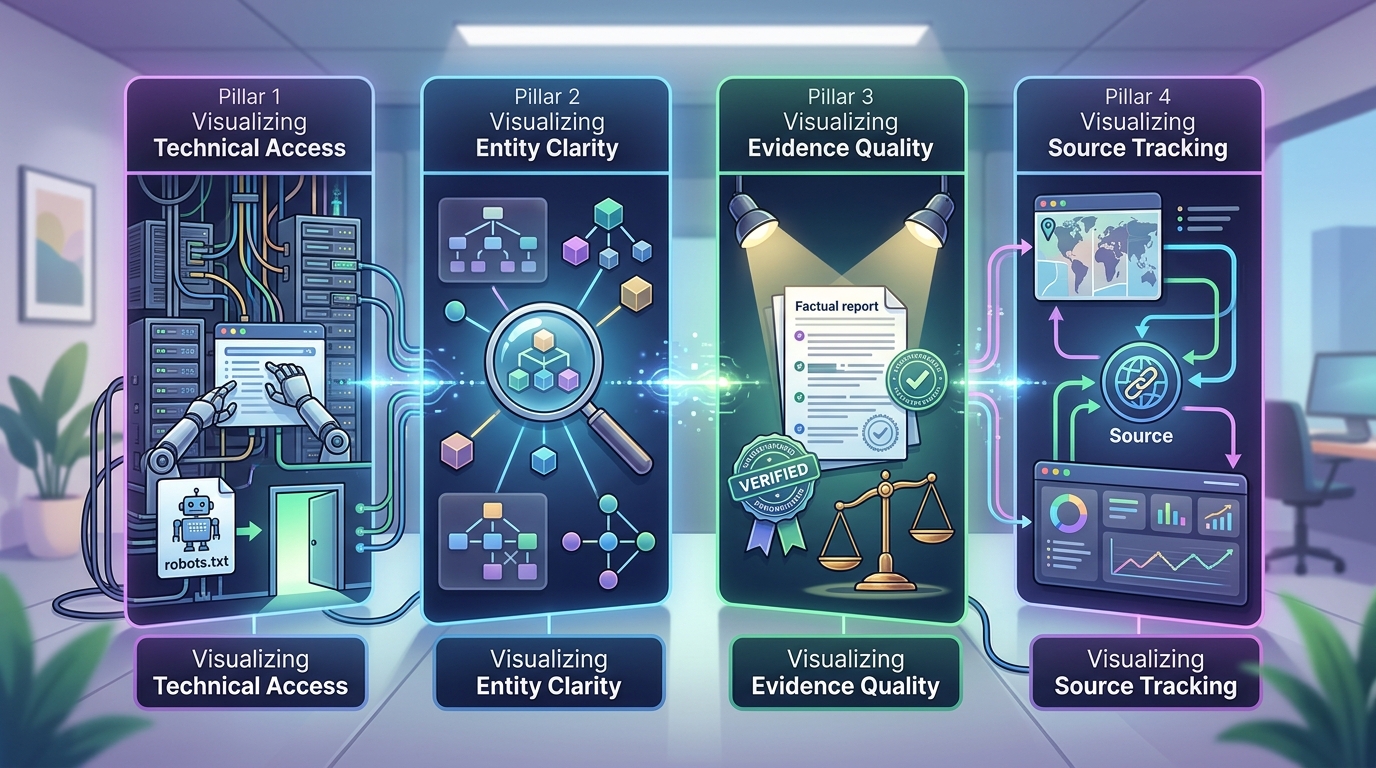
When citation readiness is the right problem to solve
Many website operators approach AI search with a fundamental question: how do I get ChatGPT to cite my website or recommend my business? This framing often leads to ineffective strategies because AI engines do not operate like traditional search engines. Traditional search indexes web pages and ranks them based on link equity and keyword matches. In contrast, AI answer engines use retrieval-augmented generation to find specific, factual passages that can answer a user's prompt. If a website fails to present its data in a structured, easily extractable format, the retrieval systems will bypass it. This is not about search engine tricks; it is about making content technically and structurally compatible with retrieval-augmented generation architectures.
A citation-readiness workflow is the appropriate response when a brand's primary research, product specifications, or industry data is omitted from AI answers despite being highly relevant. This omission usually occurs due to technical barriers, such as robots.txt files blocking AI crawlers, or structural issues like unstructured text that creates entity ambiguity. By focusing on readiness rather than guaranteed placement, a website operator aligns their digital assets with the retrieval mechanics of modern AI systems. This proactive approach makes the underlying evidence available for retrieval when an engine attempts to answer a query within a specific domain.
Map the questions your buyers actually ask
Preparing a website for AI citations begins with documenting the actual conversational queries that users input into these engines. Traditional keyword research tools often focus on short-tail search terms, which fail to capture the multi-turn, natural language structure of AI prompts. Buyers use complete sentences to ask for product comparisons, implementation steps, and specific technical capabilities. To build an accurate query map, one must extract real questions from customer support logs, technical documentation search queries, and community forums. This process shifts the focus from abstract keywords to concrete, conversational questions.
Once these questions are documented, they must be mapped to specific pages to determine if the current content library offers direct answers. If a user asks how a software application integrates with a specific platform, a generic product page is insufficient for a retrieval engine. The engine requires a dedicated page that details the integration steps, technical requirements, and data limitations. Mapping these gaps allows website operators to prioritize content creation based on documented user queries. This systematic mapping aligns content development with actual query patterns rather than speculation, providing the precise material that retrieval systems search for.

Identify the pages and evidence an answer would need
An AI engine requires clear, verifiable reference points to cite a source. When an answer engine synthesizes a response, it looks for factual assertions, structured data, and authoritative references. Website pages must be structured so that both human readers and machine parsers can easily identify the core evidence. This means using clear headings, concise summaries, and explicit data points rather than burying critical details in long, unstructured narratives. When information is presented clearly, retrieval systems can easily extract the necessary facts to support their generated answers, increasing the likelihood of attribution.
To make pages citation-ready, website operators should audit their existing priority content for specific citation signals. These signals include original data tables, peer-reviewed references, clear author credentials, and schema markup. When an AI search engine crawls a site, these elements help determine that the content is a primary source of truth rather than a secondary compilation. By strengthening these signals on core pages, a website provides the clear, verifiable evidence that retrieval systems require to confidently attribute information to a specific source.
Remove access, context, and entity ambiguity
Technical accessibility is the baseline requirement for AI visibility. If an AI crawler cannot access a website due to restrictive robots.txt directives, aggressive firewalls, or heavy client-side rendering, the site cannot be cited. Website operators must ensure that their technical setup allows user-agents associated with major AI engines to crawl and index their pages. This requires regular log analysis and technical audits to verify that content is fully rendered and accessible to non-traditional user-agents. If a site relies heavily on JavaScript to display content, pre-rendering solutions must be verified to ensure crawlers receive fully populated HTML.
Beyond technical access, website operators must eliminate entity ambiguity. AI engines rely on knowledge graphs to understand the relationships between brands, products, people, and concepts. If a website refers to a product by multiple inconsistent names or lacks structured schema markup, the engine may fail to connect the content to the user's query. Implementing clean Organization, Product, and Article schema helps anchor a brand as a distinct, recognizable entity in the eyes of retrieval systems. This structured clarity allows the engines to confidently link a brand to specific solutions and keywords within their knowledge bases.

Compare cited sources without inventing a rank
A common mistake in AI-search optimization is attempting to assign a traditional numerical rank to AI visibility. AI responses are highly dynamic, personalized, and context-dependent, making static rankings technically inaccurate. Instead of chasing a static metric, website operators should focus on analyzing the sources that AI engines currently cite for their target queries. By examining these cited sources, operators can identify the content structures, technical formats, and authority signals that the engines prefer. This helps determine whether the engines favor academic papers, official documentation, or third-party reviews for specific types of questions.
This comparative analysis reveals the gaps between a website's content and the cited sources. For example, if ChatGPT consistently cites third-party review sites or academic papers for a specific query, it indicates that self-published marketing copy is unlikely to win a citation. This insight guides content strategy, helping operators decide whether to focus on building original research, earning third-party mentions, or restructuring technical documentation. By understanding what constitutes a trusted source in a specific niche, operators can adapt their content creation to match those established expectations.
Create a remediation sequence for priority questions
Once technical gaps and content deficiencies are identified, a structured plan is required to address them. A random approach to optimization rarely yields results. Start by prioritizing questions that have high business value and where the website already possesses strong, unique evidence. This allows website operators to focus resources on areas where they have a genuine competitive advantage. By tackling these priority areas first, operators can establish a repeatable workflow for content updates and technical improvements across the entire website.
The remediation sequence should address technical blockers first, followed by entity clarity, and finally content restructuring. If the engines cannot crawl a site, no amount of high-quality content will help. Once the technical foundation is secure, operators can systematically update priority pages to include structured data, clear answers to conversational queries, and verifiable supporting evidence. This orderly approach helps align every optimization effort with a stable, accessible foundation, allowing the team to focus on verified gaps.
Limitations: no system can promise an AI citation
It is critical to understand that no tool, agency, or optimization workflow can guarantee that a website will be cited by ChatGPT, Google AI Overviews, or any other AI-search system. AI engines use complex, proprietary, and constantly evolving algorithms to generate responses. These systems prioritize user experience, safety, and factual accuracy, which means their retrieval choices can change without warning. What works today may be adjusted tomorrow as the underlying models are updated or retrained on new datasets.
Furthermore, AI search engines are subject to hallucinations, algorithmic shifts, and regional variations. A page that is cited today may not be cited tomorrow, even if no changes are made to the site. Therefore, citation readiness must be viewed as an ongoing process of technical hygiene and content quality improvement rather than a one-time optimization project with guaranteed outcomes. The goal is to make a site as easy to crawl, understand, and trust as possible, giving it the best opportunity to be utilized by retrieval systems while maintaining realistic expectations about the dynamic nature of these platforms.
| Optimization Dimension | Technical Requirement | Common Failure Mode | Verification Method |
|---|---|---|---|
| Crawler Access | Unblocked user-agents and clean rendering | Robots.txt blocking AI bots or heavy JavaScript rendering | Log file analysis and fetch simulation tools |
| Entity Clarity | Structured Schema.org markup | Missing or incomplete Organization and Product schema | Schema Validator and Rich Results Test |
| Content Structure | Direct answers to conversational queries | Vague copy with no clear headings | Manual review against target query lists |
| Evidence Quality | Primary data, citations, and author credentials | Unverified claims without supporting references | Editorial audit of source citations and author profiles |
Five Steps to Build a Citation-Ready Content Pipeline
- Identify and document the exact conversational queries your target audience uses in AI-search engines.
- Audit your technical infrastructure to allow AI crawlers to access and render your priority pages.
- Implement comprehensive schema markup to define your brand, products, and authors as clear entities.
- Restructure your content to provide direct, evidence-backed answers to specific user questions.
- Monitor cited sources for your target queries to identify shifts in retrieval preferences and adjust your strategy accordingly.
AI search engines do not guess or invent citations out of thin air; they retrieve information from sources they can easily access, parse, and verify. Your job is to make your website the most technically accessible and factually reliable source available.
FAQ
How does ChatGPT decide which websites to cite in its answers?
ChatGPT uses retrieval-augmented generation to search the web for relevant sources that address the user's prompt. It prioritizes pages that are technically accessible, structured clearly, and contain relevant, verifiable information.
Can I pay to get my website cited in Google AI Overviews?
No. There is no advertising program or payment system that allows you to purchase organic citations in Google AI Overviews. Citations are determined algorithmically based on relevance, authority, and technical accessibility.
Does structured schema markup help with AI search visibility?
Yes. Structured schema markup helps AI engines identify and understand the entities on your website, such as your organization, products, and authors. This reduces ambiguity and makes it easier for retrieval systems to process your content.
Why is my competitor cited in AI answers when my content is more detailed?
This can happen due to technical barriers on your site, such as blocked crawlers or poor rendering, or because your competitor's content is structured in a way that is easier for retrieval systems to parse and extract.
How often do AI search engines update their cited sources?
AI engines update their indexes and retrieval patterns continuously. Some systems query the web in real-time for each prompt, while others rely on periodic index updates, meaning cited sources can change frequently.